
Understanding Your Howard Miller Wall Clock
This manual unlocks your Howard Miller clock’s potential, detailing capabilities, installation, operation, and troubleshooting for a seamless timekeeping experience.
Clock Types & Movements
Howard Miller wall clocks boast a diverse range of movements, each offering unique characteristics. You might own a classic mechanical clock, relying on weights and a pendulum for power – requiring periodic winding. Alternatively, many models feature quartz movements, powered by batteries for reliable, low-maintenance operation.
Some clocks incorporate chime movements, adding melodic hourly or quarter-hourly announcements. These can be further categorized by the chime sequence – Westminster, Whittington, or others. Understanding your clock’s movement type is crucial for proper care and maintenance. Battery-operated clocks, as the manual suggests, require correct battery installation and replacement, while mechanical clocks need regular winding and occasional professional servicing to ensure longevity and accuracy.
Identifying Your Clock Model
Locating your Howard Miller clock’s model number is the first step towards accessing specific support and instructions. This number is typically found on a sticker affixed to the back of the clock case, or sometimes inside the battery compartment. It’s a unique identifier crucial for ordering replacement parts or downloading the correct manual from the official Howard Miller website.

The model number allows you to pinpoint the exact features and functionalities of your clock, including chime patterns, movement type, and any special capabilities. Knowing this information ensures you’re following the correct procedures for setup, operation, and troubleshooting, maximizing your clock’s performance and lifespan. Referencing the model number streamlines the support process significantly.
Installation & Setup
Proper installation ensures accurate timekeeping and longevity. Secure mounting, correct battery insertion, and initial time setting are vital first steps.
Mounting the Clock Securely
Before installation, carefully inspect the wall to ensure it can support the clock’s weight. Locate a wall stud for optimal stability; if unavailable, utilize appropriate wall anchors rated for the clock’s weight.
Howard Miller clocks often include specialized mounting hardware. Follow the diagrams provided with your specific model for correct bracket placement and screw usage.
Ensure the clock is level during mounting. Use a level tool to verify both horizontally and vertically. Incorrect leveling can affect pendulum swing (if applicable) and chime accuracy.
Tighten screws firmly, but avoid over-tightening, which could damage the wall or the clock’s mounting bracket. Double-check the clock’s security by gently testing its stability after installation.
Battery Installation – Types & Polarity
Your Howard Miller clock requires specific battery types for optimal performance – typically C, D, or AA batteries, depending on the model. Refer to your clock’s documentation to confirm the correct size.
Always install batteries with the correct polarity (+ and -) as indicated within the battery compartment. Incorrect polarity can damage the clock’s movement and void the warranty.
Use only high-quality alkaline batteries for extended life and reliable operation. Avoid mixing old and new batteries, or different battery types within the same clock.
Ensure the battery compartment is securely closed after installation. Regularly check for corrosion and clean the contacts if necessary to maintain a good connection.
Initial Time Setting
After battery installation, your Howard Miller clock requires initial time setting. Locate the time adjustment knob, usually found on the back of the clock face. Gently turn the knob clockwise or counterclockwise until the hour and minute hands display the correct time.
Avoid forcing the knob, as this could damage the movement. For clocks with a separate second hand, it may not be adjustable and will synchronize automatically.
If your clock features chime settings, ensure they are initially set to a desired level before fully setting the time. Double-check the time against a reliable source to ensure accuracy.
Some models may require a slight initial swing of the pendulum to start the clock.
Operating Your Howard Miller Clock
Mastering time adjustments, chime controls, and synchronization ensures optimal performance and enjoyment of your Howard Miller clock’s sophisticated features.
Setting the Time – Hour & Minute Hands
Precisely setting the time on your Howard Miller clock is crucial for accurate timekeeping. Gently pull the time-setting knob outward – typically located at the back or bottom of the clock face – to disengage the hands from the movement. Rotate the knob clockwise or counterclockwise to adjust the hour and minute hands to the correct time.
Ensure you observe the AM/PM indicator if your clock features one. Once the desired time is set, carefully push the knob back in to re-engage the hands with the movement. Avoid forcing the knob, as this could damage the delicate mechanism. Double-check the time to confirm accuracy after re-engagement. For clocks with synchronized movements, this initial setting is vital before synchronization.
Synchronizing with an Accurate Time Source
Many Howard Miller clocks offer synchronization capabilities, ensuring precise timekeeping by connecting to a reliable time source. This often involves a radio-controlled movement that receives signals from atomic clocks. To initiate synchronization, locate the synchronization button – usually on the back of the clock – and press it.
The clock will then begin searching for a signal; this process may take several minutes. Ensure the clock is within range of the signal and free from obstructions. A successful synchronization is typically indicated by a visual cue, like a steady indicator light. Regular synchronization, especially after daylight saving time changes, guarantees continued accuracy. Refer to your specific model’s instructions for detailed synchronization procedures.
Understanding Chime & Volume Controls
Howard Miller clocks are renowned for their beautiful chimes, and understanding the controls allows for personalized enjoyment. Most models feature a chime selection switch, offering options like Westminster, Bim-Bam, or hourly strike. A separate volume control adjusts the chime’s loudness, ranging from silent to a resonant tone.
Some clocks include a night silence feature, automatically muting the chimes during specified hours – typically between 10 PM and 6 AM – for undisturbed sleep. Experiment with the settings to find your preferred chime and volume levels. Consult your clock’s manual for specific control locations and functionalities, as they can vary between models. Proper adjustment enhances your clock’s auditory experience.
Troubleshooting Common Issues
Addressing common problems like a non-ticking clock, silent chimes, or a stopped pendulum ensures your Howard Miller clock continues providing accurate timekeeping.
Clock Not Ticking
If your Howard Miller clock isn’t ticking, begin with the simplest checks. First, ensure the battery is correctly installed, observing proper polarity (+/-). A weak or incorrectly positioned battery is the most frequent cause.
Next, verify the battery itself is fresh; even a seemingly full battery might lack sufficient power. If the clock utilizes a pendulum, confirm it has a full, unrestricted range of motion and isn’t obstructed by anything.
For quartz movements, gently tap the clock case – sometimes this can dislodge a stuck second hand. If these steps fail, inspect the movement for any visible damage or debris. Consider a battery replacement even if the current one appears functional, as voltage can decline over time.
Chimes Not Working
If your Howard Miller clock’s chimes are silent, several factors could be at play. First, check the chime/silent switch, often located on the back or underside of the clock – ensure it’s not set to ‘silent’.
Verify the battery has sufficient power, as low batteries can sometimes affect chime functionality even if the timekeeping remains accurate. Some models feature volume controls; confirm the volume isn’t turned down completely.
For clocks with automatic night silence, ensure the current time isn’t within the programmed silent hours. If the issue persists, gently swing the pendulum (if applicable) to potentially reset the chime mechanism. Inspect the chime rods for any obstructions. If problems continue, professional servicing may be required.
Pendulum Not Swinging (if applicable)
If your Howard Miller clock features a pendulum and it has stopped swinging, begin by ensuring the clock is hung on a perfectly level surface. Even a slight tilt can impede pendulum motion. Gently initiate the pendulum’s swing; it should continue with a steady rhythm.
Verify there are no obstructions hindering the pendulum’s path. Check the suspension spring for any damage or looseness. Low battery power can also cause pendulum stoppage, so replace the batteries with fresh ones.
Ensure the clock’s movement is properly engaged with the pendulum. If the pendulum continues to resist swinging, professional adjustment or repair might be necessary to restore its functionality.

Maintenance & Care
Regular cleaning, timely battery replacements, and preventative checks will ensure your Howard Miller clock maintains its beauty and accurate timekeeping for years.
Cleaning Your Clock
Maintaining the pristine appearance of your Howard Miller wall clock is surprisingly simple. Dust accumulation can dull the finish, so regular, gentle cleaning is key. Always use a soft, dry cloth – microfiber is ideal – to wipe down the clock’s case; Avoid abrasive cleaners, solvents, or harsh chemicals, as these can damage the wood or finish.
For more stubborn grime, lightly dampen the cloth with water, ensuring it’s wrung out thoroughly to prevent water spots. Pay attention to intricate details and carvings, using a soft brush to dislodge dust. The clock face can be carefully wiped with a clean, dry cloth. Never spray any liquid directly onto the clock; always apply it to the cloth first. Consistent, gentle cleaning will preserve the beauty and value of your Howard Miller timepiece for generations.
Battery Replacement Schedule
To ensure uninterrupted timekeeping, establishing a regular battery replacement schedule is crucial for your Howard Miller wall clock. Battery life varies depending on the clock model and battery type used – typically carbon-zinc, alkaline, or lithium. As a general guideline, replace batteries every 12-18 months, even if the clock hasn’t stopped.
However, observe your clock’s performance. If you notice the ticking becoming faint or inconsistent, or the chimes sounding weaker, it’s a clear indication that the batteries are nearing depletion. It’s always better to proactively replace them than to risk the clock stopping altogether. Keep a record of the replacement date to easily track the schedule and maintain accurate time.
Preventative Maintenance Tips
Protecting your investment requires simple preventative maintenance. Regularly dust your Howard Miller clock with a soft, lint-free cloth to prevent buildup that can affect its mechanism. Avoid using abrasive cleaners or solvents, as these can damage the finish.
Periodically inspect the mounting hardware to ensure the clock remains securely attached to the wall. Check for any signs of wear or loosening. If your clock features a pendulum, ensure it has adequate space to swing freely, avoiding any obstructions. Finally, avoid exposing the clock to extreme temperatures or humidity, as these conditions can negatively impact its performance and longevity.
Advanced Features (Model Dependent)
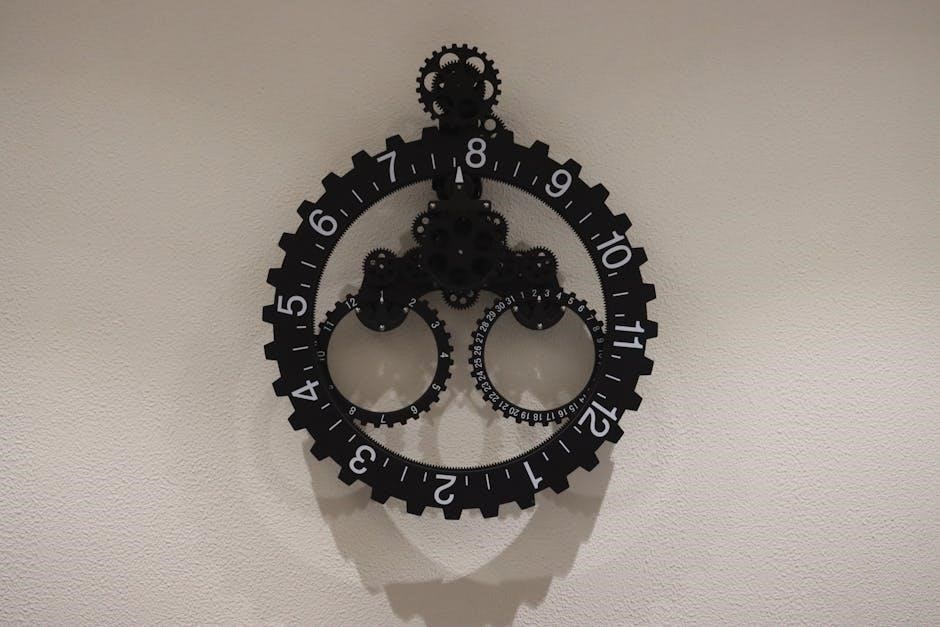
Certain Howard Miller clocks boast features like automatic night silence, moon phase displays, or calendar functions – enhancing functionality and aesthetic appeal.
Automatic Night Silence
Many Howard Miller clocks include an “Automatic Night Silence” feature, designed to provide peaceful rest during nighttime hours. This function intelligently mutes the chime or hourly strike between specified times, typically from 10:00 PM to 7:00 AM, though these times can often be adjusted.
To activate or adjust this feature, locate the night silence switch – usually a small lever or button on the back or side of the clock movement. The switch often has positions labeled “ON” or “OFF,” or may utilize symbols. When activated, the clock will operate silently during the programmed timeframe, resuming normal chiming upon the set morning hour.
Consult your specific clock model’s documentation for precise instructions, as the location and operation of the night silence control can vary. This feature ensures a tranquil environment without sacrificing the charm of your Howard Miller clock’s melodic chimes.
Moon Phase Functionality
Certain Howard Miller clocks boast a captivating Moon Phase display, accurately illustrating the current lunar cycle. This feature isn’t merely decorative; it’s a testament to the clock’s intricate mechanical engineering. The Moon Phase dial typically requires manual adjustment periodically to maintain synchronization with the actual lunar phases.
Adjustment is usually accomplished via a small screw or button located near the Moon Phase dial itself. Refer to your clock’s specific manual for the precise method, as it varies between models. Carefully rotate the adjustment mechanism until the displayed Moon Phase aligns with the current phase visible in the night sky or a reliable lunar calendar.
Regular, minor adjustments will ensure your clock’s Moon Phase display remains a beautiful and accurate reflection of celestial events, adding a touch of elegance and sophistication to your home.
Calendar Setting & Adjustment

If your Howard Miller clock features a calendar display, understanding its setting and adjustment is crucial for accurate date keeping. Typically, a small recessed button or a rotating dial controls calendar advancement. Avoid setting the calendar during the hours surrounding midnight to prevent potential mechanism damage or inaccuracies.
To set the date, gently press and hold the adjustment button while rotating the dial until the correct date is displayed. Some models may have separate adjustments for the month and day. Always double-check the date after setting, ensuring it corresponds with a reliable calendar.
For clocks with automatic calendar functions, minimal intervention is needed, but occasional verification against a known accurate date source is recommended to maintain precision.
Resources & Support
For comprehensive assistance, visit the official Howard Miller website or locate replacement parts through authorized dealers to ensure lasting clock performance.
Howard Miller Official Website
The Howard Miller website (www.howardmiller.com) serves as the primary hub for all clock-related information and support. Here, you’ll discover an extensive archive of digital manuals, specifically tailored to each clock model, offering detailed instructions for setup, operation, and maintenance.
Beyond manuals, the website features frequently asked questions (FAQs) addressing common concerns, troubleshooting guides to resolve minor issues independently, and a dedicated contact form for direct assistance from Howard Miller’s customer service team. You can also explore a rich history of the brand, showcasing their commitment to quality craftsmanship and timeless design.
Furthermore, the site provides access to warranty information, registration options for your clock, and details regarding authorized service centers should more complex repairs be necessary. Regularly checking the website ensures you have the latest updates and resources for your Howard Miller timepiece.
Finding Replacement Parts
Sourcing replacement parts for your Howard Miller clock is crucial for maintaining its functionality and longevity. The official Howard Miller website (www.howardmiller.com) offers a parts lookup tool, allowing you to identify specific components based on your clock’s model number.
Alternatively, authorized Howard Miller service centers can assist in locating and ordering the correct parts. Several reputable online retailers specializing in clock parts also carry a wide selection of Howard Miller components, including pendulums, weights, hands, and chime mechanisms.
When ordering, always verify the part number and compatibility with your clock model to ensure a proper fit. Keep your clock’s model number handy for a smooth and accurate parts-finding process, preserving its timeless operation.